


Free AI Video Generator No Sign Up: What Actually Works?
A small bathroom rarely needs more visual noise. What it usually needs is more calm, more clarity, and a better sense of balance. That is why flush ceiling lights make so much sense in compact spaces. They do not hang heavily into the room, they do not compete with the mirror, and they do not turn the ceiling into another crowded surface. Instead, they help a small bathroom feel brighter, cleaner, and easier to live with every day.
In many UK homes, bathroom size is shaped more by layout constraints than design ambition. A narrow upstairs bathroom in a terrace, a compact en-suite added to a primary bedroom, a loft conversion with restricted height, or a tiny downstairs cloakroom all have something in common: every decision shows. In a generous room, the wrong ceiling fitting might just feel slightly off. In a small bathroom, it can change the atmosphere immediately. It can make the ceiling feel lower, the room feel busier, and the whole experience feel less comfortable than it should.
That is why choosing the right ceiling light in a compact bathroom is not simply about finding something modern or minimal. It is about deciding how the room should feel in daily life. It should feel bright enough on a dark winter morning, gentle enough when you step in at night, clear enough to support the mirror area, and calm enough that the room never feels overworked. In practical spaces, comfort and usefulness matter as much as style, and often more.
A good flush fitting helps the room breathe. It keeps the upper half of the bathroom visually clear, which can make the entire space feel more settled. It also gives you freedom to think more carefully about the rest of the lighting plan. Instead of forcing one central fitting to do everything, you can let flush ceiling lights handle the overall brightness and then support the mirror area properly where needed. That usually leads to a room that feels better, not just one that looks better in a photo.
This guide looks at bathroom flush lighting from the point of view that readers actually care about most: how the room feels, how to judge what will work, what mistakes make a small bathroom feel smaller, and how to choose something that still feels right after the excitement of a renovation has passed. In other words, not just what looks good on a product page, but what works in real life.
- Why flush ceiling lights work so well in small bathrooms
- How a bathroom light should feel in daily life
- Start with the room, not the product page
- Why shape matters more than people expect
- How to use a ceiling light properly in a small bathroom
- Colour temperature, mood, and comfort
- Materials, finishes, and how to soften a compact room
- Common mistakes that make a small bathroom feel smaller
- How to choose with more confidence
- FAQ
Why Flush Ceiling Lights Work So Well in Small Bathrooms
The biggest reason is also the simplest: flush lights protect the feeling of space. In a room where the ceiling is already relatively close, anything that hangs down can start to feel intrusive very quickly. Even a fitting that is not technically large may still draw attention to itself in a way that makes the whole room feel tighter. Flush ceiling lights avoid that problem by staying close to the ceiling line. That keeps the visual field overhead calmer, which immediately helps a compact bathroom feel less crowded.
That calm matters because small bathrooms are full of hard-working features. You already have the basin, mirror, taps, vanity, shower screen, tiled surfaces, storage, and usually not much empty space between them. The eye takes all of that in at once. In that kind of setting, the ceiling should not become another place where the room feels busy. A flush fitting gives you light without creating another object that fights for attention.
There is also a more emotional reason these lights work so well. A small bathroom can feel tense when the lighting is wrong. One heavy fitting overhead can make the whole room feel a little more cramped. One harsh burst of light can make every hard surface seem colder. One awkward ceiling detail can become something you notice every day, even if you cannot immediately explain why the room never feels quite settled. Flush lights reduce that pressure. They make the room feel easier to read and easier to use, which is exactly what most people want from a practical space.
Another benefit is that flush ceiling lights often feel more timeless in small bathrooms. A dramatic fitting may be tempting at first because it appears more decorative, but compact rooms rarely reward ceiling drama for long. The fitting is too close, too central, and too visible. What felt exciting on installation day can start to feel overdone after a few months of daily use. Flush styles usually age better because they support the room rather than trying to dominate it.

How a Bathroom Light Should Feel in Daily Life
People rarely search for bathroom lighting because they want more specifications. Usually, they search because something about the room feels wrong. It may feel dim even though there is technically enough light. It may feel cold and uncomfortable first thing in the morning. The mirror may still cast awkward shadows on the face. Or the room may simply feel more cramped and more stressed than it should. In other words, readers are usually not searching for data first. They are searching for a better lived experience.
That is why it helps to imagine real moments rather than idealised product shots. Picture a winter morning when the bathroom window is barely helping at all. You switch on the ceiling light while still half awake. If the fitting is too harsh, the room feels abrupt. If it is too weak, the room feels dull and underlit. If the fitting is bulky, you notice its shape before you notice the room itself. But if the light is well chosen, the space just feels usable. The ceiling stays visually clear. The brightness feels even. The room becomes easier to move through, easier to understand, and easier to start the day in.
Now picture the bathroom in the evening. You go in to brush your teeth, wash your face, or take a quick shower before bed. At that point, the room should still feel calm. It should feel clean and capable, not glaring or clinical. This is where low-profile lighting really proves its value. Because flush ceiling lights sit quietly overhead, they let the bathroom feel composed rather than overlit. They do their job without filling the room with unnecessary tension.
These are small moments, but they are repeated constantly. A bathroom is not a space people use occasionally. It is a room they step into every morning, every evening, and often several times in between. That repeated use is why lighting mistakes feel so noticeable here. It is also why the right fitting can quietly improve the room more than expected. A well-chosen flush light supports those daily routines without asking to be admired every time.
Start With the Room, Not the Product Page
One of the easiest ways to make the wrong choice is to start with the product instead of the room. It is very easy to see a stylish fitting online, imagine it transforming the space, and forget that a real bathroom has awkward proportions, practical constraints, and a daily rhythm that matters just as much as appearance. In small rooms, that mistake shows up quickly. The light may be beautiful in isolation, but once installed, it can feel wrong because the room never asked for that much visual weight in the first place.
So before looking too closely at individual lights, it helps to read the room honestly. Is it narrow and linear, with everything arranged on one axis? Is it more square, where a centred fitting might feel balanced? Does the ceiling already feel low, even if the height is technically acceptable? Is there a sloped ceiling, an extractor, or a cabinet that makes the upper part of the room feel busier? These things matter because a light fitting never exists on its own. It is always interacting with the room around it.
It also helps to notice where the bathroom feels least successful right now. Does it feel dark overall, or only at the mirror? Does it feel cold because every surface is pale and reflective? Does it feel cluttered because too many lines compete for attention? Does it feel flat and forgettable because nothing softens the space? When you know what the room is lacking, it becomes much easier to choose a fitting that actually improves it.
This is one of the most useful judgement skills for readers. Do not ask only, “Do I like this light?” Ask, “What problem in the room is this light solving?” In compact bathrooms, that question changes everything. It stops you buying a fitting for its image and helps you buy a fitting for its effect. Often, the best answer will still be one of the simpler flush ceiling lights because those are the designs that leave the room itself feeling calmer.

Why Shape Matters More Than People Expect
Shape is not a minor decorative detail in a compact bathroom. Because the room is small, the ceiling light is always close enough to influence the atmosphere. The shape of the fitting can soften the room, sharpen it, or weigh it down. That is why form deserves more attention than it usually gets.
Round flush lights are often the easiest choice because they naturally calm a room full of straight lines. Small bathrooms usually contain mirrors, cabinets, shower frames, shelf edges, and tile joints that all push the eye in rigid directions. A circular light overhead interrupts that pattern in a gentle way. It softens the room without asking for too much notice, which makes it especially useful in bathrooms that already feel hard or overly structured.
Disc shapes create a different effect. They tend to feel more architectural and more restrained. That can be exactly right in modern bathrooms, where simplicity is part of what makes the room feel clean. A good disc-style fitting gives the ceiling a finished look without introducing decoration for decoration’s sake. In very compact spaces, that discipline can be more powerful than a more expressive form.
Glass shapes bring another kind of softness. They can add texture, reflection, and a sense of lightness at once. In a plain bathroom, that may be enough to keep the room from feeling too clinical. The key is restraint. A sculptural flush light can work beautifully when the rest of the room is quiet enough to support it, but it should still feel close to the ceiling and appropriate to the scale of the space.

How to Use a Ceiling Light Properly in a Small Bathroom
One of the most useful practical lessons for readers is this: a ceiling light should not be expected to do everything. Many bathroom lighting plans go wrong because one central fitting is being asked to light the room, flatter the face at the mirror, reduce shadows, add atmosphere, and somehow make the entire bathroom feel larger. That is too much to ask from a single fitting, especially in a compact space.
The better approach is layered lighting. In that arrangement, the flush ceiling light handles the room’s ambient light. Its job is to make the bathroom feel open, usable, and visually balanced. It should provide the general brightness that lets the space feel clear and comfortable. Then the mirror area should handle the more detailed work. That is where readers shave, apply skincare, check makeup, style hair, or simply want to see their face properly in a flattering light.
Once you understand that, buying becomes much easier. You stop trying to force the ceiling fitting to carry the whole room. That means you can choose flush ceiling lights for what they are best at: creating an even and calming base layer. The result is usually more attractive and more practical. The room feels brighter overall, but the useful areas also feel better lit where it matters most.
- Use the flush ceiling light for overall room brightness and atmosphere.
- Add mirror lighting or an illuminated mirror for face-level clarity.
- Avoid relying on one strong centre fitting to solve the whole room.
- Keep the ceiling visually calm so the bathroom feels more open.
Colour Temperature, Mood, and Comfort
Colour temperature sounds technical, but for most people it becomes an emotional decision very quickly. It affects how flattering the mirror feels, how the tiles read, how clean the room looks, and whether the bathroom feels fresh or severe. In a compact bathroom, that effect becomes even stronger because there is less space for the light to soften before it reaches the eye.
A tone that is too cool can make hard surfaces feel harsher than they really are. That can work in some crisp contemporary spaces, but in many smaller bathrooms it pushes the room too far towards clinical. On the other hand, a tone that is too warm can occasionally reduce clarity, especially in bathrooms that already lack daylight. That is why context matters more than trend.
A bathroom with warm stone tones, beige tile, brushed finishes, timber touches, or softer off-whites often benefits from a slightly gentler, warm-to-neutral feeling. It supports the warmth already in the room and makes the space feel more settled. A bathroom built around white sanitaryware, pale grey tile, black details, and a cleaner modern look may suit a more neutral tone that keeps everything looking sharp and clear.
The timing of use matters too. A busy family bathroom that comes to life early each morning may benefit from a fresher, clearer feeling. A small en-suite connected to a bedroom often feels better with a softer tone that suits quieter evening use. The best choice is not the most fashionable temperature. It is the one that supports the life of the room.
Materials, Finishes, and How to Soften a Compact Room
Many small bathrooms already contain enough hard surfaces. Tile, mirror, ceramic, glass, chrome, and painted walls can make a space feel bright and hygienic, but they can also make it feel a little cold if every finish is too stark. Because compact bathrooms have less room for decorative softness elsewhere, the ceiling light can play a subtle but important role in balancing that mood.
This does not mean the room needs a decorative statement. It means the finish and material feel of the fitting should respond to what the space already has. A black-edged or sharply graphic flush light may work very well in a bathroom with framed shower glass, darker hardware, or strong contrast. But in a room that already feels slightly severe, that same fitting may push things too far.
Warmer details can be surprisingly effective here. A fitting with a wood accent, a softer beige note, or a warmer visual texture can make a compact bathroom feel more human and less clinical. This is especially useful in cloakrooms or smaller en-suites where the room is neat but a little emotionally flat. One warm note overhead can shift the atmosphere without changing the whole style of the room.

The best approach is always to look at what the room is missing. If it feels cold, bring warmth. If it feels busy, simplify. If it feels flat, add a little texture or softness. Good lighting choices respond to the room rather than overpowering it. That is one reason flush ceiling lights are often such a strong answer in smaller bathrooms: they leave more room for the atmosphere to settle naturally.
Common Mistakes That Make a Small Bathroom Feel Smaller
The first mistake is chasing a statement when the room really needs calm. Small bathrooms rarely benefit from a ceiling light that insists on being the centrepiece. In larger spaces, feature lighting can be decorative. In compact bathrooms, it often becomes pressure. The room ends up feeling more crowded overhead and less comfortable overall.
The second mistake is focusing only on brightness. A fitting can be technically bright and still feel wrong. It can create a harsh hotspot under the centre, bounce unhelpfully off glossy surfaces, or leave the mirror area less useful than expected. What compact bathrooms need most is not brute brightness. It is useful, even, balanced light.
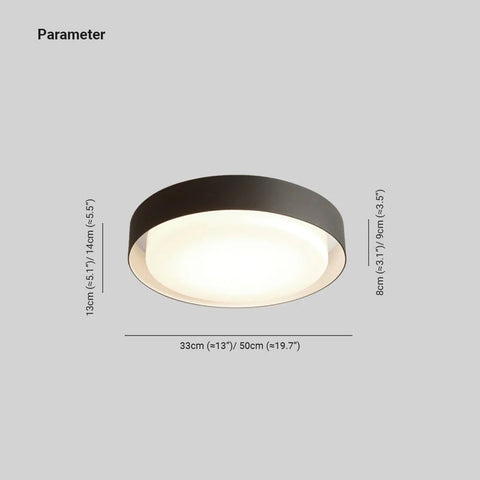
The third mistake is ignoring how visually heavy a fitting feels. This is not always about size. A fitting can be the right diameter and still feel too dense because of thick trim, dark weight, or a more layered silhouette. In small spaces, visual weight matters as much as physical size. If the fitting is the first thing you imagine when you picture the room, it may already be asking for too much attention.
The fourth mistake is expecting the ceiling light to solve the mirror area on its own. This often leaves the room looking bright enough in general, but frustrating in practice. The face still falls into shadow. Grooming tasks still feel awkward. The room never quite feels finished. That is why layering matters so much.
How to Choose With More Confidence
If there is one reliable way to make a better choice, it is this: decide what the room needs before deciding what looks good in isolation. A small bathroom usually needs one of four things. It needs to feel less cramped. Less cold. Less shadowy. Or less visually busy. Once you know which of those problems you are trying to solve, choosing becomes much easier.
Then think in three steps. First, choose the right visual weight. In compact spaces, a lighter, calmer presence usually wins. Second, choose the right shape. Round shapes soften the room. Disc shapes streamline it. Softer glass or warm textures can add interest where the room feels too stark. Third, choose the finish according to what the bathroom is missing. Warmth helps a clinical room. Simplicity helps a busy one. Texture helps a flat one.
It also helps to imagine the room in real use rather than in a styled renovation image. Think about the steam after a shower, the mirror on a dark morning, the speed of getting ready before work, the quiet routine at night. A good bathroom light supports those ordinary moments. It should still feel right on a rushed weekday, not just on the day the renovation photos are taken.
This is why flush ceiling lights continue to make so much sense in small bathrooms. They are practical without feeling dull. They are neat without feeling cold. They help the room feel more spacious without demanding extra attention. Most of all, they improve the experience of using the bathroom every day, which is what good design is supposed to do.
Read Next
Explore practical flush ceiling light ideas, mirror support, and low-ceiling options for small UK bathrooms.
Browse bathroom wall lights that work beside or above the mirror, adding safer task lighting in compact bathrooms.
FAQ
Are flush ceiling lights good for small bathrooms?
Yes. They are often one of the best choices for small bathrooms because they stay close to the ceiling, reduce visual clutter, and help the room feel more open. In compact spaces, that cleaner ceiling line makes a noticeable difference to how comfortable the room feels.
Do I still need mirror lighting if I have a flush ceiling light?
In many cases, yes. A flush ceiling light is ideal for general room lighting, but mirror lighting helps with face-level clarity for tasks like shaving, skincare, and makeup. The best small bathrooms usually feel balanced because the ceiling light and mirror lighting are sharing the work.
What shape works best in a compact bathroom?
Round and slim disc-style flush lights are usually the easiest choices. Round fittings soften a room full of straight lines, while disc-style fittings feel neat and modern. The better option depends on whether your bathroom needs softening or simplifying.
How do I make a small bathroom feel brighter without making it feel harsh?
Focus on even light spread rather than simply choosing the strongest fitting. Keep the ceiling visually calm, avoid overly bulky shapes, and use mirror lighting for task support. That usually creates a bathroom that feels brighter and more comfortable rather than glaring.
Are simple flush ceiling lights easier to maintain?
Usually, yes. Low-profile lights with smoother surfaces tend to be easier to wipe down and less likely to collect visible dust or residue in awkward areas. In a bathroom, that practicality is worth a lot because the fitting stays in clear view every day.

