


Best Pendant Lights for Small Dining Rooms
Dining Room Lighting Guide
A small dining room can be one of the warmest places in a home. It is where weekday dinners happen without ceremony, where children finish homework while a pan is still on the hob, where guests linger a little longer than planned because the room feels gentle and easy to stay in. Yet it is also one of the spaces most easily spoiled by the wrong light. In a compact room, a pendant does not just hang overhead. It becomes part of the daily mood. It shapes the view from the hallway, the feeling of the table after dark, and the way the room holds ordinary life.
That is why choosing pendant lights for a small dining room should never be treated as a purely technical decision. Yes, size matters. Height matters. Material matters. But what most people really notice is simpler than that. Does the room feel softer? Does the table feel anchored? Does dinner feel calmer? Or does the light make the room feel crowded, overexposed, and slightly harder to enjoy? In larger rooms, you can often get away with a fitting that is a little too bold, a little too deep, or a little too decorative. In small rooms, every choice is felt more directly.
Many buying guides start with numbers and stop there. They tell you what diameter might fit, what drop might work, or how many lumens sound sensible. Those details have their place, but they do not answer the questions most readers actually care about. The real question is how the light behaves in everyday life. A pendant may look beautiful in a staged product image and still feel too heavy once it is hanging over a four-seat table beside a wall radiator, a sideboard, and a couple of chairs that are never perfectly pushed in. A light may technically fit the room and still make it look smaller than it needs to.
This guide takes a more lived-in approach. It is for people trying to make a compact dining room feel finished, welcoming and easy to use. It is for the narrow terrace dining room, the small square room in a semi, the bay-window table, the banquette nook beside the kitchen, or the open-plan dining corner that needs enough identity to feel like a place rather than an afterthought. Instead of giving you more parameters to juggle, this article focuses on judgement. How to tell if a pendant will feel visually heavy. When glass helps. When fabric is better. Whether one pendant is enough. How to make the room feel warm after dark. And how to choose a light that improves not only the look of the room, but the experience of being in it.
Contents
- Why small dining rooms need a different approach
- What people really want from this room
- How to judge a pendant before you buy
- Best materials for small dining rooms
- How to choose the right size without overthinking
- One pendant or a cluster?
- How to use the light well every day
- Mistakes that make a room feel smaller
- Real home scenarios
- Shopping the range more clearly
- FAQ
Why small dining rooms need a different approach
In a large dining room, a pendant has the luxury of distance. There is enough surrounding space for the eye to step back, enough volume for a stronger shape to settle in, and often enough secondary furniture or lighting to share the visual load. A small dining room works differently. The pendant is seen from closer range. It is noticed from more angles. It affects the room immediately because there is nowhere for it to hide. That means the wrong fitting can make itself felt within seconds.
What often goes wrong is not obvious at first. The light may not be “too big” in the strict sense. It may not hang absurdly low. Yet it can still feel too present. It may carry too much visual weight, block the room in the centre, or add a kind of downward pressure that makes the whole dining area feel more cramped. This is especially common with deep shades, dark solid finishes, and designs that look sculptural in isolation but become heavy once they are surrounded by real furniture, everyday objects, and the slightly imperfect rhythm of home life.
Small rooms also magnify glare. When the walls are closer, the ceiling is standard height, and the table is never far from a nearby surface, harsh light bounces more aggressively than people expect. The result is often a room that feels flatter and more exposed in the evening, even if the pendant looked elegant in the day. That is why softness matters so much more than many guides admit. In a dining room, especially a compact one, comfort should be part of the visual brief.
Ultimately, the goal is not to make the pendant invisible. A dining table needs a centre. It benefits from a sense of intention. But the light should give shape without making the room feel blocked. It should settle the table rather than dominate it. The best pendant lights for small dining rooms are usually the ones that do not force the room to work around them. Instead, they make the room feel as though it has gently fallen into place.
The easiest way to judge a small-room pendant: it should make the table feel more grounded and the room feel more open at the same time.
What people really want from this room
When someone searches for the best pendant lights for a small dining room, they are rarely just asking for a ceiling fitting. More often, they are trying to fix a feeling. Perhaps the room looks unfinished. Perhaps the current ceiling light is bright but joyless. Perhaps the table feels like it has been placed in the room rather than properly held by it. Sometimes the room is not ugly at all, only slightly unloved. It works, but it does not yet have the softness or calm people want when the day is ending and everyone is finally sitting down.
That emotional side matters more than people often say. In a small dining room, the light affects how long you want to stay at the table. A good pendant makes a modest meal feel more intentional. It can make the room feel less rushed and more considered, even when nothing else has changed. The chairs are the same. The table is the same. The wall colour is the same. And yet the room feels gentler, more coherent, more welcoming. This is one of the reasons lighting can transform a room without asking for a full redesign.
Readers also want reassurance. They want to know that the pendant they choose will still look right once it leaves the product page and enters a real home with everyday clutter, low winter daylight, people passing through, and all the visual complexity that makes an actual room different from a styled photograph. They want to know whether the fitting will age well in the space, whether it will still feel calm six months later, and whether it will support the room instead of constantly asking to be noticed.
That is why buying advice for compact dining rooms works best when it is rooted in ordinary life. The right pendant is not necessarily the one that photographs best on a white background. It is the one that feels composed above a small table at 7pm, with bowls on the table, a coat on one chair, a little glare from the window already gone, and the rest of the house quietly visible around it. That is the moment a dining room light has to earn its place.

How to judge a pendant before you buy
One of the most useful skills when shopping for dining room pendant lights is learning to judge visual weight. This matters more than most measurements. Two pendants can share similar dimensions and still behave very differently in a room. One can look airy and graceful. The other can feel dense and overbearing. The difference usually comes down to material, depth, silhouette, and how much of the fitting reads as a solid object once it is seen in context.
Look for air around the form
A pendant often feels lighter when the eye can move around it or through it. Clear glass is the most obvious example because it keeps the room visually open. Light clusters can work in a similar way because the eye reads the spacing between elements rather than one single mass. Even opal glass and soft lantern forms can feel breathable if their outline stays gentle and their volume does not become too dense. If the fitting looks like one compact block suspended over the table, it is more likely to add visual pressure to a small room.
Pay attention to depth
Many people focus only on width, yet depth is often what makes a pendant feel too much in a compact room. A broad, shallow shade may feel calm and stable, while a narrow but deep shade can look heavier because it pushes further down into the space. In standard-height homes, this matters enormously. A pendant that drops with too much visual mass can make the centre of the room feel busy before anything else in the room has been noticed.
Imagine the view from the doorway
A good test is to stop thinking like a shopper and start thinking like someone walking past the room. What happens when you see the pendant from the hall, the kitchen entrance, or the sofa? Does it quietly settle the dining area, or does it become the first and heaviest thing the eye meets? In a compact home, the light is rarely experienced in isolation. It lives within wider sightlines, so it needs to behave well from outside the room too.
Picture an ordinary evening
This is perhaps the most useful test of all. Do not imagine the table perfectly styled. Imagine the room as it usually is: chairs not entirely aligned, a bowl or vase still on the table, plates coming and going, daylight already gone, and the pendant switched on as the main mood-setter. A fitting that still feels composed in that scene is usually the right sort of choice. The best pendants are not only photogenic. They are forgiving.
For that reason, it helps to browse the main dining room pendant lights collection slowly and compare a few lighter options side by side rather than getting pulled towards the most dramatic image first. A calmer choice often reads better in a real home.
Best materials for small dining rooms
Glass: the easiest way to keep the room open
Glass is often the safest and most successful starting point for small dining rooms because it does not interrupt the space as heavily as opaque materials do. Clear glass allows the room to continue visually through the fitting, which helps preserve a sense of openness even when the pendant has a visible shape. This can make a remarkable difference in smaller homes where the table sits near a window, within an open-plan layout, or in a space that is crossed visually from several directions every day.
Clear glass also works well because it feels less final. It does not stamp itself onto the room in the same way a dark metal dome or a thick opaque shade can. Instead, it contributes shape while still leaving the room breathable. In a compact dining room, that balance is often what keeps the space from looking overfilled.
Opal glass is slightly different, and in many ways even more useful. It still feels lighter than a solid shade, yet it diffuses light beautifully. That soft glow is especially flattering in the evening. Faces look gentler. Timber looks warmer. Plates and linens do not catch harsh glare so quickly. If your dining room feels a little cold or flat after dark, opal glass can be one of the simplest ways to improve both comfort and atmosphere at once.
Fabric: warmth, softness and a calmer evening mood
Fabric shades bring something different to a small dining room. They do not open up the room in the transparent way glass does, but they soften it emotionally. They blur the bulb source, smooth out contrast and make the dining area feel more settled once natural light has faded. In British homes especially, where dining rooms often contain painted woodwork, curtains, timber tables or plaster walls, fabric can feel at home very quickly.
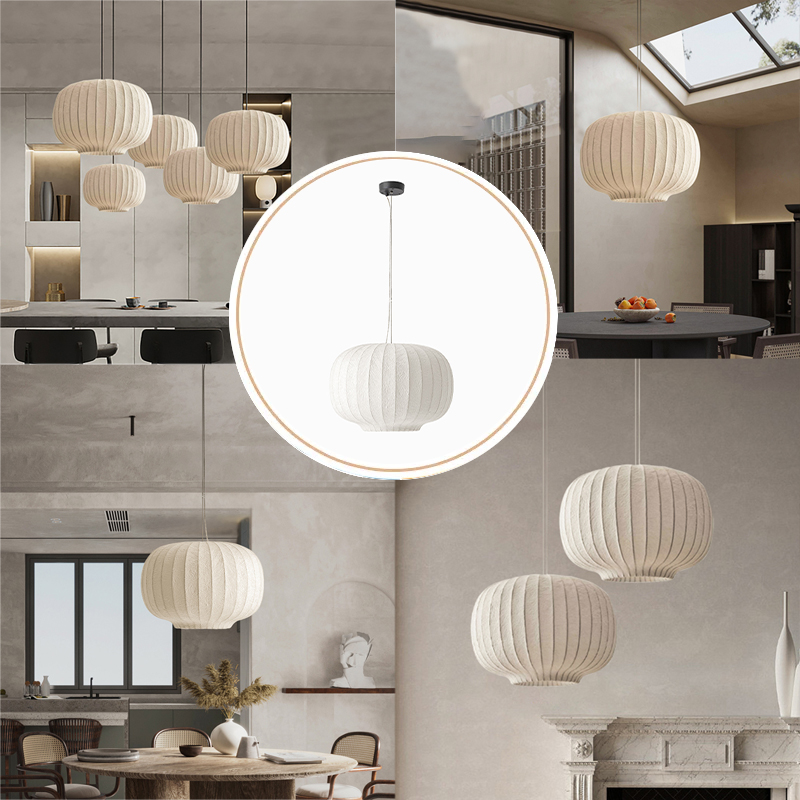
There is also an intimacy to fabric that suits compact spaces. A small dining area often wants to feel held rather than displayed. Fabric shades, especially lantern-like or lightly pleated designs, create that sort of comfort well. The key is to keep the form controlled. A heavy closed drum can still feel bulky, but a softer shape with air in its outline often works beautifully.
Fabric is a strong choice when the room already has enough lines and hard surfaces. If the area sits beside kitchen cabinetry, shelving, tiles or black metal details, a fabric pendant can soften the whole composition and stop the room feeling too crisp or severe.

Clusters: useful when the room needs presence without bulk
Clusters are often misunderstood in small spaces. People sometimes assume they are automatically too busy, but a well-judged cluster can actually feel lighter than one oversized shade. That is because the eye reads the spaces between the elements. If the materials are airy and the grouping is modest, the result can be decorative without becoming dense.
Clusters are especially useful in open-plan dining corners where the table needs a stronger sense of identity. One large solid pendant might look like an obstacle from across the room, while a light glass cluster can define the table with more elegance. The important thing is restraint. The cluster should feel gathered, not sprawling. It should create rhythm, not visual clutter.
For anyone thinking along those lines, the cluster pendant lights collection is worth browsing after the main dining category. It is often the right next step when a room needs a little more occasion without becoming visually heavy.
How to choose the right size without overthinking
People often feel stuck on sizing because they worry about getting it wrong in visible, irreversible ways. The truth is that the eye reads proportion more naturally than most formulas suggest. In a small dining room, what usually matters most is not whether the pendant hits an exact number, but whether it leaves enough breathing space around the table to keep the room calm.
A useful way to think about it is this: the pendant should feel large enough to belong to the table, but not so dominant that it becomes the room’s main object from every angle. If it appears to push too close to chair backs, shelving, wall art or nearby furniture, it will likely feel cramped in use. If it feels too small, the table can look disconnected from the ceiling, as though the fitting belongs vaguely to the room rather than properly to the dining area.
In many compact rooms, broader and shallower forms feel better than deep and narrow ones. This is because depth tends to read as weight. A pendant can be a respectable width and still feel light if it does not press too far down into the room. Conversely, a relatively narrow pendant can look heavy if its drop and depth make it behave like a downward mass. This is one reason why so many small rooms look better with opal globes, fabric lanterns, shallow domes or light clusters than with thick industrial shades.
For round tables, a single rounded gesture usually works best. For small rectangular tables, one centred pendant can still look beautiful, though slim linear designs may suit the layout if the room already has a clean directional quality. Either way, the room should still feel relaxed with the chairs slightly out and the table in use. If the pendant only looks right when the room is perfectly tidy, it may not be the right pendant for everyday life.
A practical rule: in a small dining room, choose the pendant that makes the room feel composed on a normal weekday, not only the one that looks impressive in isolation.
One pendant or a cluster?
In many compact dining rooms, one pendant is not just enough. It is often the best answer. One fitting gives the table a clear centre, keeps the room simple, and avoids the slight fussiness that can happen when too many elements are introduced into a small visual field. If the room already has furniture, art, window dressings or strong architectural details, a single pendant often lets those existing elements breathe more naturally.
The question is whether one pendant can do enough. In many cases, yes. A single opal glass pendant, a soft globe, a fabric lantern or a shallow dome can light a four-seat table beautifully while keeping the room relaxed. The key is not the number of fittings, but whether the chosen pendant has enough presence to anchor the table and enough softness to avoid glare.
A cluster becomes more useful when the room needs clearer definition or a touch more decorative interest. In open-plan layouts especially, the dining area sometimes benefits from a stronger visual marker. A cluster can provide that without producing one large opaque object in the middle of the space. This works particularly well when the cluster uses glass or similarly light materials and keeps its overall footprint modest.
So the better question is not “Which is more stylish?” but “What does the room need?” If the room needs calm, one pendant often wins. If the room needs presence without bulk, a careful cluster may be the better answer. The more honestly you read the room, the easier this choice becomes.

How to use the light well every day
Choosing the right pendant is only half the story. In a small dining room, the way the light is positioned and used matters just as much because one fitting often carries most of the room’s atmosphere. A good pendant can still underperform if it hangs in the wrong place, if the glow is too harsh, or if it is never adjusted to suit the time of day.
Centre the light over the table, not the room
This is the simplest rule and one of the most important. In smaller homes, the dining table is not always in the exact middle of the room. It may sit closer to one wall, beside a bay window, near kitchen cabinetry, or within an open-plan corner. The pendant should follow the table, not the architecture. If it is centred to the room instead, the arrangement often feels subtly wrong every time you walk past it.
Prioritise evening comfort
Daylight hides a lot. Evening reveals everything. A pendant that looks clean and stylish in bright afternoon light can feel surprisingly harsh after dark if the bulb source is exposed or the shade throws too much direct glare downward. Dining rooms are used emotionally at night. That is when they need to soften people, surfaces and mood. Materials like opal glass and fabric perform especially well here because they diffuse the light more gently.
Use dimming if possible
Dimmable lighting is especially valuable in compact dining rooms because one pendant often has to handle multiple roles. Breakfast wants clarity. Homework or reading needs focus. Dinner benefits from warmth. A late drink or quiet conversation wants the room to recede a little. Dimming allows the same fitting to move across those moods without making the room feel overlit or flat.
Think about the seated view
In a small room, the pendant is seen at closer range when people are sitting down. That means the bottom edge of the shade, the visibility of the bulb, and the amount of glare all matter more than they would in a large space. A light should not feel like a barrier between people on opposite sides of the table. Nor should it create such a bright hotspot on the table that the rest of the room falls away into dullness.
The best pendant lights are the ones that quietly support daily routines. They make the room easier to use and nicer to stay in. They do not demand attention every time they are switched on. Instead, they help the room feel settled in a way that becomes part of home life almost without notice.
Mistakes that make a room feel smaller
One of the most common mistakes is choosing the smallest possible pendant out of fear. On paper, this sounds sensible. In practice, it can leave the dining table looking underlit and oddly disconnected, as though it has never been properly acknowledged within the room. Small spaces still need intention. A pendant should not apologise for being there.
Another mistake is choosing a design that is heavier than the room can absorb. Dark metal, thick opaque shades, deep industrial forms and visually dense finishes can all look striking in the right home. But in a compact dining room already full of chairs, joinery, wall art or everyday objects, they can make the centre of the room feel blocked. In such spaces, lighter materials usually do more.
A third mistake is buying for the daytime photo rather than for evening life. Many people fall for a fitting because it looks sharp and sculptural online. Then, once installed, it creates glare, flattens the room, or feels too severe after dusk. Dining rooms must work hardest after dark. That should always be part of the decision.
There is also the problem of overcompensating. When a compact dining room feels plain, it is tempting to add interest everywhere at once: a patterned rug, a gallery wall, dramatic chairs, and a statement pendant. Sometimes the room does not need more ideas. It simply needs one good focal point handled with restraint. In smaller rooms, clarity often looks richer than excess.
Good signs
- The pendant gives the table a centre without taking over the whole room.
- The room still feels open when chairs are pulled out and dinner is in progress.
- The light is soft enough for evening meals and ordinary daily use.
- The pendant looks calm from the doorway as well as from the table.
Warning signs
- The shade feels deeper or denser than the room really needs.
- The eye notices the pendant before it notices the table.
- The bulb source feels obvious and slightly harsh when seated.
- The design looks glamorous online but hard to live with in a real room.
Real home scenarios
A narrow Victorian or Edwardian dining room
These rooms often have beautiful proportions, though not much spare width. There may be a chimney breast, alcoves, a sideboard or shelving, so the pendant does not need to provide all the room’s character on its own. In this setting, opal glass and softer fabric forms usually work especially well. They respect the room’s architecture and create warmth without making the centre feel crowded. A dark heavy shade in this context can easily tip the room from elegant to congested.
A compact square room with a four-seat table
Square rooms often benefit from one clear central gesture. A single pendant tends to feel more natural here than something overly stretched or busy. Rounded forms are particularly effective because they soften the middle of the room and make the table feel deliberately placed. If the room already has storage on one wall or a window that draws the eye, the pendant should cooperate rather than compete.
An open-plan kitchen-dining corner
Open-plan homes ask more from a dining pendant because the fitting needs to define a zone without becoming a visual divider. In these spaces, glass is often especially useful because it keeps sightlines open. A small cluster can also work beautifully when one single shade seems too slight and one large shade feels too blocky. The aim is to mark the table, not fence it off. If this is your layout, you may also find Dining Room Pendant Lights for Open Plan Rooms a helpful companion read.
A bay-window table
A dining table beside a bay is one of the loveliest small-room arrangements when the lighting is right. The pendant is often seen against natural light during the day, so heavier opaque forms can feel abrupt. Glass and opal glass tend to sit more gracefully in this setting, especially once evening comes and the room starts glowing back towards the window. A soft rounded pendant often feels most at home here.
A dining nook or banquette corner
Nooks want intimacy more than drama. They are often used close up, and the seating itself already creates a cosy feeling. In these spaces, lantern forms, pleated fabric and other softer shapes tend to work best. Something too angular or severe can quickly feel awkward because the room is already asking for comfort. The better choice is usually the one that supports that softness rather than trying to contradict it.
A small room with a round table
Round dining tables often look best under one clear, centred gesture. A globe, a rounded shade or a small gathered cluster tends to echo the shape below and make the composition feel naturally resolved. If your table is round and your room is compact, there is often no need to overcomplicate the choice. One balanced pendant is usually enough. For more shape-specific ideas, Best Pendant Lights for Round Dining Tables is worth reading alongside this guide.
Shopping the range more clearly
Online shopping makes every pendant look more self-contained than it will feel in a real room. That is why a slower, more deliberate approach usually leads to better results. Instead of starting with whatever design looks most impressive on the page, begin with what the room needs. Does it need more openness? More softness? A little more visual definition over the table? Once that is clear, the search becomes much easier.
If the room feels cramped or visually busy already, start with glass. If it feels cold or a little severe after dark, start with softer opal glass or fabric. If the room is open-plan and the table feels a bit lost, explore light clusters. Working this way stops the search becoming purely aesthetic and helps keep it tied to the actual experience of the room.
It is also helpful to picture the product in your home at a normal moment rather than a perfect one. Think about the view from the kitchen. Think about winter evenings. Think about the chairs not always being pushed in. Think about the light with dinner on the table rather than with a styled vase and nothing else. The fitting that still feels calm in that imagined scene is usually the one worth choosing.
For most readers, the easiest path is to begin with the main dining room pendant lights collection, compare a few lighter glass and fabric options first, and then move to cluster pendant lights if the room needs more layered presence. That sequence tends to produce clearer decisions than jumping straight into the most dramatic product image.
Further reading
FAQ
What size pendant works best in a small dining room?
The best size is usually one that gives the table a clear centre while leaving visible breathing space around it. In compact rooms, visual weight matters more than raw measurement. A pendant can be a reasonable width and still feel too heavy if it is deep or dense. Shallow forms, opal glass, soft fabric and light clusters often work especially well.
Can one pendant be enough for a four-seat dining table?
Yes, very often. In many small dining rooms, one pendant is the cleanest and most elegant answer. The key is choosing a fitting that has enough presence to anchor the table and enough softness to light it comfortably without glare.
Do glass pendants make a room feel bigger?
They often help. Clear glass keeps sightlines open, while opal glass stays visually lighter than many opaque materials and softens the light at the same time. Both can help a compact dining room feel less blocked and more breathable.
Are cluster pendants too busy for small spaces?
Not necessarily. A compact, airy cluster can work beautifully in a small dining room, especially in glass. The important thing is that the cluster feels gathered rather than sprawling and does not become a dense visual mass above the table.
Is dimmable lighting worth it in a small dining room?
Usually, yes. A small dining room often depends on one main pendant more than a larger room does. Dimming helps the same fitting move from practical daytime use to a softer evening mood, which makes the room much easier to live with.
What type of pendant suits a dining nook or banquette?
Dining nooks usually suit softer forms such as lanterns, fabric shades or gentle opal glass. These styles support the intimacy of the nook and make the area feel warmer and more inviting without looking harsh or oversized.
Final thoughts
A small dining room does not need grand gestures. It needs the right one. The best pendant is rarely the loudest object in the room. More often, it is the fitting that makes the table feel properly held, softens the room after dark, and leaves enough visual air for the whole space to breathe. That kind of balance is what turns a compact dining area from merely functional into somewhere people genuinely want to sit.
Glass, opal glass, fabric and lighter clusters all have a strong place in that conversation because they solve the real problems of compact rooms. They reduce heaviness, improve atmosphere and support daily life rather than interrupting it. In real homes, that is usually what matters most.
If you are choosing for a smaller dining room, it is worth browsing the range with comfort, softness and visual lightness in mind. The right pendant will not just look better overhead. It will make the room feel easier to enjoy every day.
Explore Dining Room Pendant Lights


