


Outdoor Wall Lights: IP44 vs IP65 for UK Homes
A good-looking fitting can still be the wrong one for a British exterior wall. A doorway that looks sheltered in daylight can still catch wind-driven rain and stay damp long after the weather has cleared. That is why outdoor wall lights should not be chosen on style alone. Read the wall first, then the IP rating, then the beam and finish. The real decision for most homes is simple: does this spot need IP44, or does it really need IP65?
IP44 vs IP65 in plain English
The short answer is simple.
-
A properly covered porch can often use IP44.
-
A front door with only a shallow canopy is usually safer with IP65.
-
A fully exposed side wall, rear wall or passage should go straight to IP65.
That is the decision most homes need. The rest of the article is really about judging which of those three situations the wall belongs to.
The IP code itself does not need a long lecture. It simply tells how well a fitting resists solids and moisture. IP44 means protection against small solids and splashing water. IP65 steps up to dust-tight protection and resistance to water jets. In everyday terms, IP44 suits lighter exposure, while IP65 is the stronger choice for walls that deal with more rain, grime and open weather.
That is also why the word “waterproof” is not enough on its own. It sounds reassuring, yet it does not say how much exposure the fitting is meant to handle. The IP rating does. For a blog like this, that matters more than marketing language, because the aim is not to decode a label for its own sake. The aim is to stop a porch light being under-specified for a wall that stays damp half the winter.
How to choose outdoor wall lights by wall exposure
The easiest way to choose is to ignore the fitting for a moment and look at the wall. Start above the fixing point. Is there a real porch roof, with depth and side shelter, or just a narrow projecting cap? Those two things are often described in exactly the same way on estate-agent photos, yet they behave very differently in bad weather.
Next, look at how water moves. Brick sills, rough render, ledges, drainpipes and even door canopies can send rain exactly where it should not go. A front door may look partly protected, but if water runs down the face of the wall beside it, the fitting is still taking a hard hit.
After that, think about exposure from the side. Open drives, corner plots, side passages and west-facing elevations usually work harder than recessed entrances. So does any wall that sees wind pushing rain straight across it. A deep porch in a terrace and a shallow canopy on an open new-build frontage are not the same environment, even if both are loosely called “the front door”.
Finally, notice how the wall dries. Some entrances are dry again by midday. Others stay dark and damp for hours, especially on shaded brick or render. If the wall holds moisture for long periods, leaning towards IP65 is rarely a mistake.
The three UK house scenarios that settle the choice fastest
1. A proper covered porch
This is the classic case where IP44 can be enough. The doorway sits back from the line of the house. There is a full porch roof overhead, and the fitting is not catching direct rain every time the weather turns. In that setting, the light mainly deals with damp air, occasional blown drizzle and the general mess of outdoor life.
That does not mean every porch gets IP44 automatically. Some porches are open at both sides, and some shallow brick recesses look more sheltered than they are. Still, where the entrance is genuinely set back and shielded, IP44 often makes sense. It avoids pushing a genuinely sheltered entrance towards a tougher spec than it really needs.
A covered porch also tends to suit calmer, more domestic-looking shapes. The fitting is seen at close range. It sits near eye level. It needs to help with keys, locks and parcel drops without turning the entrance into a security flood zone. In those cases, a neat wall-mounted piece or a slim linear light usually works better than an oversized lantern or a heavy block.

For porch areas that are modern, narrow or slightly more open to weather, Clowas’s Outdoor Linear Wall Light Black Waterproof Motion Sensor for Porch is a sensible reference point. The product page confirms IP65 protection, a slim black profile, multiple lengths and a motion-sensor option, which makes it a natural fit for recessed entries, front doors and garage-side approaches where a cleaner line suits the architecture.
2. A front door with only shallow cover
This is the awkward middle ground, and it is where most mistakes happen. A small canopy over the door can create the impression of shelter, yet the wall beside the frame may still take direct rain. In British weather, that usually means wind-driven moisture across the face of the elevation, not just a little splash below the canopy.
For that reason, IP65 is normally the safer call on a front door with only shallow cover. The entrance may still look tidy and domestic, but the fitting is working in a harder spot than a proper porch light. There is simply less margin for optimistic spec choices.
This is also where scale matters. On a narrow reveal, a short or compact fitting usually sits best. On a broader frontage, especially one with a garage door, wider brick bay or large rendered return, a longer linear piece can feel far more settled. The Clowas linear design is available in multiple lengths from 30cm upwards, so the shape can be matched to the wall rather than forced onto it.
There is another reason this scenario favours IP65. Front entrances tend to gather everything at once: wet coats, school bags, bins on collection night, takeaway drop-offs, muddy shoes, driveway splashback and the occasional hose-down near the threshold. So even when the wall is not fully open to the weather, the fitting often deals with more day-to-day outdoor mess than a simple definition of “porch” suggests.
3. A fully exposed side wall or rear wall
This one is easy. Choose IP65.
A side passage, rear kitchen wall, garden-facing elevation or garage flank usually sees more weather than the front entrance. Rain reaches it directly. Dirt collects there. Moisture lingers. In narrower side returns, air movement can make conditions feel harsher rather than calmer, because wind tends to push rain and debris right along the wall.
These walls also work differently at night. They are less about greeting the entrance and more about making movement safe and readable. That is why practical beam control, easier upkeep and stronger sealing matter more here than decorative detail. A fully exposed wall should not rely on a rating that only makes sense in a partly sheltered position.

Clowas’s Outdoor Aluminum Black Wall Light, IP65 Waterproof fits that brief well. The product page describes a black aluminium body, IP65 protection and use across exterior walls, porches and balconies, which makes it a stronger candidate for long-term exposure than a lighter-duty fitting intended mainly for covered entrances.
What usually goes wrong when the rating is chosen too quickly
The most common mistake is assuming that “porch” is a fixed category. It is not. One porch is a deep recess with proper cover. Another is little more than a decorative lip above the door. Those walls do not deserve the same answer.
Another common slip is buying around the words modern, black, minimalist or waterproof and skipping the harder question of exposure. That approach works indoors. Outdoors, it often leads to a fitting that looks right on the page and feels wrong six months later. The finish may still look smart, yet the location was asking more of it than the spec really offered.
Then there is the opposite problem: underestimating how wet a “not fully exposed” wall actually is. Shallow canopies, west-facing doors and open drives are the usual culprits. If the house sits where rain sweeps across the front rather than dropping straight down, the more protective rating is generally the better bet.
After the IP decision, look at size before style
Once the wall has been classified, the next question is scale. A light can have exactly the right IP rating and still look badly chosen if its proportions are wrong for the façade.
Small entrances usually need restraint. A compact fitting or shorter linear form tends to sit better beside a single front door, especially on older terraces, narrow semis and modest porches. The aim there is clear, comfortable light close to the threshold, not a large decorative statement.
Wider frontages are different. A long blank stretch of render, a broader brick bay or the flank wall of a garage can make a tiny fitting look underpowered before it is switched on. In those cases, a longer linear shape often gives the wall a proper visual line and stops the light source feeling lost in the masonry.
That is one of the stronger things about the Clowas range. The main collection includes compact forms, linear pieces, sensor-led options and up-and-down designs, so the decision can move from wall condition to scale and only then to style. That sequence is far closer to how a good exterior scheme actually comes together.
Beam shape changes the result more than most people expect
Brightness is not the whole story. Beam shape usually affects comfort first.
For a front door, the most useful result is often a controlled wash that makes the lock, threshold and step readable. A light that throws straight into the face from close range can be surprisingly irritating, even if the lumen output looks modest on paper. That is why softer forward throw or a diffused linear format often works so well around entrances.
On broader frontages and exposed elevations, an up-and-down beam can be far more architectural. It gives the wall shape, creates a cleaner night-time outline and suits modern brick, render and dark cladding particularly well. Instead of a single bright patch, the façade gets a composed beam pattern that feels built into the architecture.
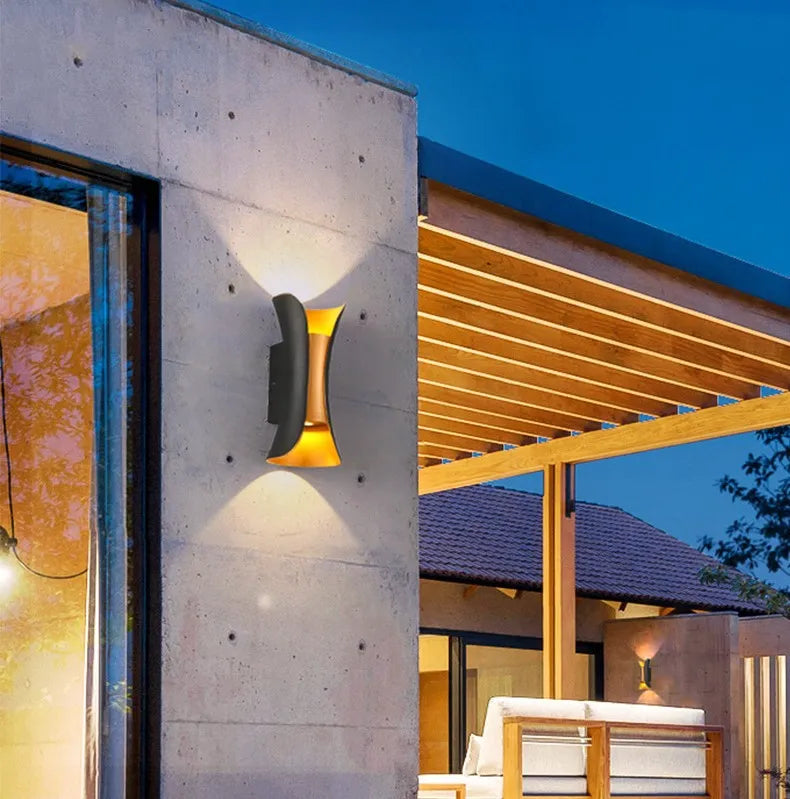
That is where the Exterior Up and Down LED Wall Light, Modern Curved Design, IP65 starts to make sense. Clowas presents it as an exterior up-and-down fitting with IP65 protection and a curved modern profile, which suits wider elevations, cleaner façades and entrances where the wall itself is part of the visual effect. For a broader browse in that direction, the outdoor up and down lights category is the natural next click.
There is also a practical side to beam shape. In a side passage or back-door route, the wall often needs to support movement rather than appearance. Here, a direct, useful beam or a motion-led fitting can be more valuable than an architectural light pattern. The point is not to force every wall into the same look. It is to let the wall decide what kind of light it actually needs.
When a sensor makes more sense than a standard fitting
Some locations are not used like a front entrance. A side gate, passage, garage approach or utility door tends to be visited in short bursts. In those places, a sensor-led design often feels more sensible than a permanently lit fitting.
That is especially true in narrow passages where light is only needed when someone steps into the space. A sensor helps keep the route practical without leaving a bright point running all night. It can also make smaller or secondary entrances feel easier to use without demanding a more formal lighting scheme.
Clowas has a dedicated outside lights with sensor category, and the collection description focuses on motion detection, better visibility and improved efficiency outdoors. That makes it a good secondary path for side passages, garage approaches and entrances where convenience is more important than decorative beam play.
The important point here is that sensor use should match routine. At a main front door, a steady and comfortable beam may be better if the entrance is used constantly through the evening. At a side path or garage wall, sensor activation often feels cleaner and more useful. Good exterior lighting follows habits around the house rather than forcing every elevation into the same pattern.
The role of material and finish in a British setting
Once the rating, scale and beam are settled, finish becomes easier to judge. Black remains popular for a reason. It sits quietly against brick, render, timber and darker door colours, and it tends to work across both older and newer homes without shouting for attention.
Aluminium is also worth noting in exposed positions. A black aluminium fitting usually looks crisp on modern façades and practical on service walls, which is why it so often appears in IP65 designs intended for tougher spots. Clowas’s aluminium IP65 wall light is a good example of that approach, pairing a simple dark finish with a shape that still has some character.
Curved or sculpted forms work best where the wall has enough width around them. They need a little space to breathe. By contrast, compact or linear pieces often sit more naturally beside narrow reveals, smaller porches and secondary doorways.
This is also why a fitting that looks dramatic in isolation can feel wrong once mounted. The wall, the door frame, the brick bond and the canopy all compete for attention. A good exterior wall light should settle into that composition. It should not fight with it.
Four Clowas product directions that fit this buying journey
A slim linear fitting for porches, front doors and garage edges
This is the easiest route for modern entrances. A linear wall light has a tidy footprint, gives a clear vertical or horizontal line to the wall and usually feels more current than a bulky lantern. In the Clowas range, the Outdoor Linear Wall Light Black Waterproof Motion Sensor for Porch is the clearest example, because it combines a slim black finish, IP65 protection and a motion-sensor option across multiple lengths. It suits recessed porches, shallow-cover front doors and garage-side entries particularly well.
A stronger IP65 aluminium piece for genuinely exposed walls
Where the wall is open to the elements, the Outdoor Aluminum Black Wall Light, IP65 Waterproof feels more grounded. The aluminium construction and IP65 rating are already aligned with the job, and the wave-inspired shape avoids the flat, purely utilitarian look that some hard-working exterior fittings can fall into. It is the kind of piece that can sit on an exposed brick return or rendered rear wall without looking temporary.
An up-and-down fitting for façade shape
Some walls want more than threshold light. They want a beam pattern that gives the house depth after dark. In that case, the curved IP65 up-and-down option is the better direction. It works especially well on wider frontages, clean rendered surfaces and contemporary builds where the lighting is expected to contribute to the façade rather than simply illuminate the handle. For a wider browse beyond one product, the outdoor up and down lights collection is the right path.
A compact mounted option for smaller entrance zones
Some houses simply need a smaller, tighter-fitting solution. Narrow porches, side doors and modest entry points can look clumsy with a long linear piece or a strongly projected wall lamp. In that case, Clowas’s Modern Black Outdoor Wall Mounted Light Waterproof for Porch is an easy one to keep in mind, because the product page confirms IP65 protection and a compact wall-mounted form that suits porches, patios and exterior walls without taking over the entrance.

The reason this smaller format works is simple. Not every entrance needs a long feature light. On a narrow reveal or side doorway, a compact mounted piece often looks more settled and more deliberate than a fitting chosen mainly because it looked striking in isolation.
Small buying cues that help before the order is placed
A porch light should usually feel comfortable from a short distance. That means the fitting should not project too far into the standing space or throw glare straight out at face height. Closer entrances often benefit from softer, contained light rather than raw brightness.
On exposed side or rear walls, easier cleaning matters more than many product pages admit. Dirt, webs and rain marks are simply more visible there. A neat shape and a durable finish can make upkeep less annoying over time, especially on black fittings where dust shows more clearly.
For wider walls, it is often wiser to size up the fitting rather than overcompensate with beam harshness. A longer body can look more balanced on a broad façade while keeping the light itself calm. The Clowas linear range is useful precisely because it is available in several lengths, so scale can be matched to the elevation rather than guessed.
Likewise, a secondary entrance does not need to mimic the front door. It can be simpler, tougher and more functional. A side passage with bins and bikes rarely needs a decorative beam. It needs reliable light at the right moment, which is why the sensor-led category often makes more sense there than a more formal façade piece.
Installation and use notes worth keeping in mind
Even a well-rated fitting can disappoint if it is placed badly. The common trouble spots are directly beneath a drip line, too close to a downpipe, or on a surface that leaves obvious gaps behind the backplate. Those problems are not caused by the rating itself. They come from the wall and the install.
Old brick, rough render and uneven stone also deserve a little caution. A sleek product photo usually shows a perfect flat backdrop. Real British exterior walls are rarely that polite. A fitting that sits neatly on a smooth render board may need more care on a weathered terrace or pebble-dash return.
It is also worth thinking about what the light is supposed to do every evening. At the main front door, the right answer may be a steady, comfortable source. At a side path, the right answer may be a sensor. At a rear garden wall, the right answer may be a quieter architectural beam. A product is easier to choose when the daily routine is clear first.
Where hardwiring is involved, professional installation is the sensible route. Outdoor fittings sit in a damp environment, and exterior wiring details matter. The product itself may be right, yet the final performance still depends on how cleanly and appropriately it is fitted to the wall. Clowas also recommends qualified electrician installation on relevant product pages, which is the right standard for this category.
FAQ
Is IP44 enough for a covered porch?
Yes, often. If the porch is properly covered and the fitting sits back from direct rain, IP44 can be enough for the job. The key phrase there is properly covered. A deep porch roof with a real recess is different from a token canopy over the door. Once the wall starts catching more wind-driven rain, the argument shifts towards IP65.
When is IP65 the better choice for a front door?
IP65 is usually the better choice when the front door has only shallow cover, faces open weather or sits on a wall that stays damp after rain. It is also the steadier option where driveway splashback, road grime or open side exposure add extra stress to the fitting. In other words, once the entrance behaves more like an exterior wall than a sheltered recess, IP65 makes more sense.
Is a shallow canopy enough to make IP44 safe?
Not always. A shallow canopy protects less than it appears to, especially on windy or weather-facing elevations. The door handle may stay dry while the wall light beside it still gets wet. That is why shallow-cover entrances so often end up in the IP65 camp, even though the householder might instinctively describe them as “partly sheltered”.
Are IP65 lights always better than IP44?
No. They are more protective, but that does not automatically make them the better buy for every wall. On a genuinely covered porch, IP44 may be entirely appropriate. The better choice is the one that matches the location without forcing the fitting to be bulkier, harsher or more industrial-looking than the entrance needs.
What type of wall light works best on a fully exposed wall?
An IP65 fitting with a practical beam and durable finish usually works best. On a service wall, side passage or rear elevation, reliability matters more than ornament. That often points towards a neat linear form, a compact mounted block or an up-and-down design with solid sealing, depending on whether the aim is route lighting or façade effect. The aluminium IP65 wall light and the curved up-and-down Clowas option are both good examples of that direction.
Do IP65 lights still need careful installation?
Yes. IP65 is strong protection, not a free pass for poor placement. A fitting mounted under constant runoff or badly sealed at cable entry can still underperform. So the rating should be seen as the right starting point for the wall, with correct installation finishing the job.
Further reading
For readers who want the visual side after settling the IP question, Outdoor Wall Light Trends 2026: Sleek LEDs for Patios & Porches is the natural follow-on. It leans into slimmer bodies, softer beams and more controlled exterior styling.
For anyone also thinking about comfort in gardens and side paths, Outdoor LED Lighting That Attracts Fewer Bugs: Smarter Colour Picks for UK Gardens is a useful companion read. It is especially relevant where beam control, colour temperature and calmer evening lighting matter as much as weather protection.
Final takeaway
For most UK homes, the decision can be reduced to one rule: read the wall honestly. A truly covered porch can often use IP44. A front door with only shallow cover is usually better served by IP65. A side wall, rear wall or passage with full exposure should not bother pretending — it needs IP65.
After that, the buying process becomes much easier.
-
Judge the wall first: real shelter, shallow cover or open exposure.
-
Match the beam to the job: calm threshold light, sensor-led practicality or façade effect.
-
Only then choose the shape and finish.
For a broad starting point, browse the full outdoor wall lights collection. For more practical routes and side-access convenience, the outside lights with sensor category is the better path. For cleaner beam patterns and a more architectural frontage, head to outdoor up and down lights.

